

What is Cell-free Synthetic Biology?
Proteins—polymers of amino acids—are a major class of biomolecules whose myriad functions facilitate many crucial biological processes. Accordingly, human control over these biological processes depends upon the ability to study, produce, and modify proteins. One innovative tool for accomplishing these aims is cell-free protein synthesis (CFPS). This method, rather than using living cells to make protein, simply extracts the cells’ natural protein-making machinery and then uses it to produce protein in vitro.
Engineering Within a Cell-free System
Because living cells are no longer involved, scientists can freely adapt and engineer the protein production environment in ways not otherwise possible. This increased accessibility enables cutting-edge research on current topics such as unnatural amino acid insertion, virus-like particle production, enzyme immobilization, and high-throughput assays.
These exciting areas of study have the potential to contribute to biotherapeutics, recombinant enzyme development, cancer research, and more (see image to right).
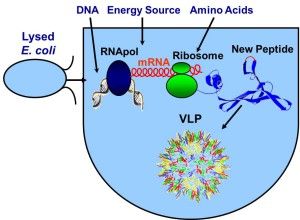
For a narrated explanation of CFPS, click here.